Monday, March 31, 2025

 Marks of History

            When I was in the sixth grade I learned about modern Brazilian history. The teacher told us about The Cold War. It was a moment when the United States, capitalists, and Soviet Union, socialists, were fighting against each other indirectly. Research, technology improvement and development were happening. However, this period, when the world was “divided” between capitalist and communist system, interfered in the politic system in Brazil as well. Therefore, to fight against communism, the military in Brazil established a dictatorship, which lasted from 1964 to 1985. The dictators benefited people that were involved with the movement, such as the military and their families, yet the dictatorship was mostly based on censorship, repression and torture. Furthermore, Brazilian dictatorship influenced people’s customs, thoughts and values, and it wouldn’t be different with my family. 

9 músicas para entender a ditadura militar no Brasil - Blog do Unasp

            My father’s side of my family was pressured into supporting the military. My great-grandfather was a middle age military officer. He had four teenage daughters and three teenage sons when the dictatorship began in Brazil. In this period, the information about the country situation was limited only to the army, and if they shared it with someone, even with their family, it could be a problem. For that reason, my family members believed that nothing corrupt was happening. In addition, they were living in a military area and going to a military school. My great-grandfather’s children always felt protected and safe. As a result, they still believe the dictatorship in Brazil was not an authoritarian or anti-democratic period. 

Ditadura Militar no Brasil: Repressão, Resistência, Impactos

            Although one side of my family was in the military, my mother’s side suffered the consequences of the dictatorship. My grandmother was a teenager when everything began. Her family was never involved with politics. However, they were not in a protected area, so everyone was treated as suspects. My grandmother lost years of her adolescence. One day her father sold one part of his electric cables to a military officer, but he didn’t know the guy was involved with the army. Even though my grandmother’s father wasn’t involved with politics, the military denounced my great-grandfather because he was selling cables that people should have been buying from the government. After that, my great-grandparents didn’t let their children go out alone. My grandmother couldn’t go out with friends or leave the house to go somewhere else beside school. The tension lasted for a long time. 
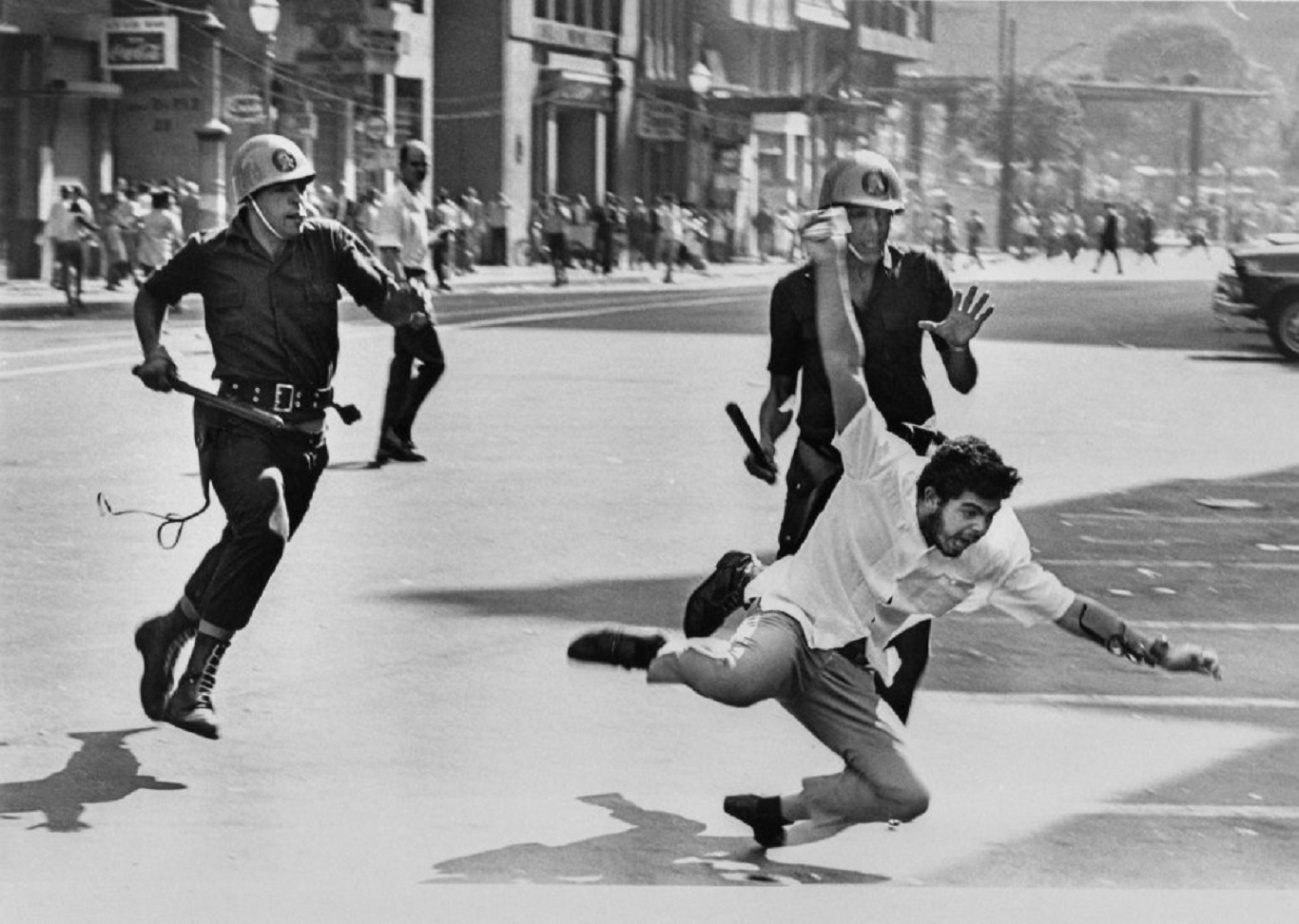
60 anos do Golpe Militar de 1964: uma reflexão necessária sobre democracia  e direitos | Comunica UFU

             Consequently, having a family on both sides of the dictatorship has always influenced how my family members think and communicate. My father’s side thinks that it was a good period for the country, but they never really talk about that. On the other hand, I always try to share information about the dictatorship with the younger generation, because I think it is important to know about our country and the historical process. There are documentaries, movies and music that capture the real scenario of Brazil, between 1964 and 1985. In fact, this year a movie called “I’m still here” won the best international movie performance. The movie shows an important part of the dictatorship and how this period influenced people’s life. In addition, I always try to show my siblings and cousins and be open to talk about the authoritarianism in Brazil. 

I'm Still Here - The Nickelodeon

            A country’s historical process always influences people’s values and customs, as such the dictatorship influenced my family daily life. The event divided the country, as well my family, but it also thought me how to respect and hear people. Each experience is unique, and sometimes people just reproduce what they learn or replicate what they see and hear. For that reason, I always try to show to my sibling and cousins sources that they will have the right information. I learned that it is important to learn from more experienced people, but it is also important to search and have my own thoughts. 

Sunday, March 30, 2025

Memorial Nightmare

 Ibrahim Toure

February 25, 2025

ESL 100-CE

  Memorial Nightmare

March 26 has been celebrated as a Memorial Day in Mali because of the Coup d'Etat that was led mainly by the military Amadou Toumani Toure against the President Moussa Traore. A Coup d’Etat is an attempt by the military with the help of the population to unseat the leadership of a country. In Mali, there have been many military Coups, but that one was the one that had the most terrible effects. That day, the military organized a protest, and most of the population was part of it because they were obsessed, and they wanted to show their dissatisfaction. Some consequences of the Coup were the destruction of a lot of public properties and even private properties of innocent people. The amount of death at that event was over three hundred people. The main cause of the Coup was because most of the population blamed the regime of corruption and mismanagement causing the undevelopment of the country.  My grandfather was the minister of education at that time, so he was part of the regime. He faced most consequences just as the president himself. Because my grandfather was part of the government during the Coup, it made him, and his family suffer a lot.

At the end of the Coup, my grandfather was arrested and faced charges for economic crimes and murder. He was put in a guarded villa waiting for his judgment for more than twelve years. While there he had to let go all other projects he was maintaining. If he was not at the office, he was on his field. He was big farmer, but he couldn’t find anybody of trust to help him take care of his land while he was in jail. At first, his staff were trying to help him take care of it, but they could not handle it. My grandfather had a financial loss for the harvest he had grown that year. That was all the money he had left because everything else was taken from him. In addition, the living conditions were also intense for him while being guarded. He was constantly moved to other regions, so he couldn’t even see his family like he wanted to. He went into depression because of the turning of his life. He went from powerful and rich to powerless and poor. 

During the time that followed the Coup, my grandmother had her own nightmare due to these events. My grandfather was the only one working. He was in charge of everything, so when he was arrested, his wife needed to take care of things for herself and her children. They had to find somewhere to live because their house was destroyed the day of the Coup. She started working really hard in small trades, so they could be able to at least have food. Moreover, she was obligated at a time to move to Senegal, a neighboring country of Mali. She had to do that because as years were passing, there was still anger in some people's hearts. In order not to be  judged everywhere, she had to leave the country, and her husband while not being able to do anything for him, but she also had to do it to protect her children.


My mother was not in Mali when the event happened, yet she didn't suffer less than the others. She first came to the U.S for her studies on a scholarship, but she couldn’t go back to Mali because there was so much going on in the country. She was stuck in the U.S. as a refugee. She ended up living among other people from Mali that were also here in the U.S., but they turned against her. Most of them were supposed to be her friends, but they were bullying her, harassing her, calling her a thief. Some people even used these same exact words: daughter of a criminal. However, after finishing her studies, she got a green card and became a citizen. I would  say in all that happened, that was the only positive thing. My mother finally got married with my father who had been protecting her during her family's hard time and found her beautiful family.

This military coup had a lot of bad effects in Mali and even Malians living abroad. My grandmother and my mother struggled a lot. My grandfather wasted twelve years of his life waiting for a judgment for which he was not even pronounced guilty. When this kind of distress comes up, it is considered as a nightmare that will persist. However, they all tried to keep the positive part of this event. Because after this hard time, they were able to live a normal life, and there will be a story to tell the descendants of this family. 


Indelible Mark


            “Those who do not know their history are condemned to repeat it”. This is a quote from the Spanish philosopher George Santayana. However, I grew up hearing it because of the dark time in Colombia during the era of Pablo Escobar. Pablo Escobar was the most powerful drug trafficker in Colombia between the 1970s and 1990s. He led the Medellin Cartel, which sent tons of cocaine to the United States and made billions of dollars. He was seen as a hero by some people because he helped poor communities, but at the same time he brought extreme violence to Colombia. The Colombian government, with the help of the United States, tried to stop him for years. He escaped from prison many times, but finally in 1991, the police killed him in a police operation. The crimes of the Pablo Escobar left a mark on Colombia and on my family for generations that continues to this day.

            Many people were affected by the confrontations between the government and Pablo Escobar, and one of them was my grandfather. He lived on a farm in the mountains where he worked with coffee plantations. It was an attractive area for Escobar to hide because of the large mountains and the difficult roads to get there. The cars could not enter the area because there were no streets, so my grandfather had to walk forty-five minutes to get to the nearest street. This was not a problem for Escobar because when he wanted to hide from the Colombian military he arrived by helicopter. On the contrary, it was an advantage to make it more difficult to find him. The Colombian military arrived in the area to confront him with bombs. Because of that, my grandfather had to leave for fear of the bombs and the violence that was happening in his area. Six months later, my grandfather’s farm and coffee plantations were destroyed. All the years of effort, his work, home, and life had been lost. My grandfather asked the government for help. However, the government said that it was collateral damage and did not help him.

            In addition, my parents who lived in the capital, Bogota, had to live through the violence and fear of everyday life. Pablo Escobar was mostly against the government, so there were many attacks in the capital where the government was located. The kidnappings, assassinations, and bombings happened on the daily news in Colombia. Escobar made attacks in different areas of the city against innocent people to scare the government and stop them from confronting him. For this reason, my mother preferred to stay at home for fear that something would happen to her and my brother. On the other hand, my father had to go to work in the center of the city, where most of the attacks took place. In 1998, Escobar bombed a police building in Bogota, and my father was only a few blocks away when it happened.  Fortunately, my father had only minor injuries. My parents had to endure those situations for ten years.

            Even though I did not have to live through Pablo Escobar’s era, the mark he left on Colombia continues to have effects on my generation. Pablo Escobar’s Netflix show became very popular around the world causing many people from other countries to recognize Colombia only because of him. Many people began to relate Colombians to the bad actions of Pablo Escobar and acquired bad reputation. As a result, it became more difficult for Colombians to apply for visas, and there was more control and attention at the airports. The show is not completely real. It is also dramatized to get the public's attention. This caused people to be misinformed. Since I arrived in Chicago, I have received comments related with Pablo Escobar because of my nationality. When I say that I am from Colombia, some people immediately make comments like, Do you have cocaine? I love Pablo Escobar; Pablo Escobar is the best. It is difficult for me to hear these comments and even more difficult to know that many people admire Pablo Escobar without knowing all the pain he caused in the country.

            Colombia is an amazing country with a hard past that touched my grandfather and my parents. Unfortunately, due to the misinformation of some people, his legacy is still felt at the present. The era of Pablo Escobar caused many people to lose everything, like my grandfather. It made Colombians live in fear for a long time and brought a lot of violence to the country. Finally, it left an indelible mark on Colombia that no one knows if it may never fade. I hope that someday people will recognize Colombia for all the incredible things it has and not for a man who caused suffering and violence in the country.


From the Seed to the Fruit

  From the Seed to the Fruit

In 2023, Bagadadji, a neighbourhood in Bamako, the capital of  Mali, celebrated its hundred year anniversary. This is the neighbourhood where my family has been living for years.  A big celebration took place with a lot of activities and the story of my family was told. Since that day, a huge excitement has been created in my mind to find out more about it. Everything started with Talmahamane Toure, also known as Sidi Mohamad Ben Sallah. Talmahamane was a merchant and traveled from city to city. During his travels, he used to invite the population that he met to Islam. Originally from Tuat, which is actually located in Algeria, he is the first of my family’s ancestors who came to Mali in the eighteenth century. Today, my cousins, my siblings and I are the tenth or eleventh generation in Bamako. Being the one who brought Islam to Bamako, the story of Talmahamane continues to give my family an important place in the city.


In Bamako, three families share the title of founder of the city. There are the Niares, Toures and Draves. When Sidi Mohamad Ben Sallah arrived in Bamako, there was only the Niares family. They were animists, which refers to people who believe that objects and all natural things such as plants and animals have spirit. Thus, Talmahamane took the initiative to tell them about Islam. Step by step, a peaceful and progressive conversion of Niares into the Muslim religion took place. Talmahamane managed the islamic education of children and all new Muslims. Being Muslims, it is not possible to talk about Islam without prayers, and it is not possible to talk about prayers without mosques.  Indeed, Talmahamane built the first mosque in an animist land but more important the first mosque in the history of Bamako. Now, there are a lot of mosques in the city. The management of the Grand Mosque of Bamako, which is located in Bagadadji, goes to my family. It is the sign of truth that the Malian government has for the Toures in that domain. My family is one of the references in the Malian social life. 


Indeed, my family has played a role in religious and civic matters in Mali. Those are either used to clarify or to solve issues in the country. In a religious way, between the three founding families, the Draves and my family are the ones who are considered to know the most  about the subject. If someone needs to be advised and he goes to the Niares, they will either guide them to  the Draves or my family. Moreover, politicians frequently get advice from my family when there are tensions in the political life of the country,  and my family  has handled many cases. In 2020, Malians were unhappy with the President Ibrahim Boubacar Keita, and then he decided to come to Bagadadji. They had discussions with our family representatives about whose role it was to find a solution  and  convince the opposition to stop the manifesto. People come to get advice from my family because they know our history and they believe that solutions can be found to their problems.

Even after centuries have passed, my family is still living by following Talmahamane’s steps. All the privileges that my family has today are only because Sid Mohamad Ben Sallah came to Bamako and we are grateful. By remembering the beginning of everything, we give the opportunity to our traditions to continue to be alive and to the new generation to go back to their roots. To show that, during events such weddings and births, they are usually celebrated at Talmahame’s mosque where he is buried. Additionally, my family members pursue the traditions that Talmahamane and his family left behind and they have been passed down  from generation to generation. For the Prophet Muhammad’s birthday, Sidi Mohamad Ben Sallah initiated a reading of the Quran, the religious text of Islam, during the twelve first nights at his mosque, and the exchanges of meals with the Draves’ family. Year after year, at the same event, my family practices this tradition. 

Just like a seed that develops its roots, goes through multiple steps to become a plant and then to produce fruits, my family also went through several steps before having that position in the Malian society. It all started with Sidi Mohamad Ben Sallah, and it still continues with his descendants. His arrival in Bamako had influenced the religious and social life of the city and the country, and gave my family responsibilities. Pursuing his traditions and celebrating big events in his mosque are a sign of gratitude from my family to Talmahamane. By learning more about my ancestors, I realized that regardless of where people end up, they all must always remember their origins.


Friday, March 28, 2025

Shadows of The Great Cultural Revolution


Shadows of The Great Cultural Revolution

My grandfather always said that the period of The Great Cultural Revolution was a terrible time in China and a horrible time for his family. In 1966, Mao Zedong, the chairman of Chinese government, wanted to develop communism and remove all capitalist influences. He believed that everyone should be equal, and individual property should not exist in Chinese society. If anyone disagreed with his opinion or looked forward to having capitalist lifestyle, such as doing private business, learning foreign culture, or having relationship with foreigners, they would be considered as betrayers. They would face the risk of losing all property, being arrested, or being sent to the farm and receive moral education. During this period, it was easy to falsely accuse and frame someone. My grandfather was falsely accused because he inherited a luxurious house from my great-grandfather, and someone was jealous of it. This house was built with the help of some overseas funds. In addition, my family had some relatives abroad at that time. The government believed that my family had some relationship with foreign countries, so my grandfather’s house was confiscated. It was lucky that my grandfather had not been arrested, only lost his house. He always comforted himself by saying this. However, I could feel his pain and sadness through his eyes when he told me this story. The Great Cultural Revolution made my family suffer a lot of difficulties. Even now, as the youngest generation, my siblings and I are still affected by its indirect influences.

My grandmother told me that my grandfather seemed to have aged ten years overnight after losing his house. He became reticent and was always smoking to relieve his depression. Losing the house meant losing everything for him. My grandfather not only lost his property, but also lost his spirit. This house was the only property his father left him. In addition, my grandfather and his children were all born there, so this house held many of their valuable memories. The value of this house could not only be measured by money. After living in a relative’s house for several months and avoiding being homeless, my grandfather wanted to build another house. He was poor at that time. Luckily, my grandfather’s relatives and friends were willing to lend him some money to build a house. My grandfather was grateful for their help and tried his best to earn more and pay back the money as soon as possible, as everybody had a rough economic situation. However, private business was not allowed during this period. The only source of income for most people was farming. My grandfather could only make some handcrafts secretly in a cave and sell them at the illegal market. Therefore, my grandfather had to farm during the day and try to earn extra money at night.


In addition, my oldest uncle, an eight-year-old boy at that time, suddenly became as mature as an adult. As the eldest child in the family, while his brother just knew playing with friends and his sister was a baby who couldn’t walk, he knew the influences of this revolution and the meaning of losing a house. Therefore, he wanted to protect and take care of his family as a man. He shared housework with my grandmother like feeding chickens and cooking. He also needed to take care of his youngest brother and sister. What’s more, my oldest uncle needed to help my grandparents build the house, as they didn’t hire others to save money. They built the house themselves. My oldest uncle’s job was to move building materials. It was hard work, but he never complained. At an age when he could play with friends without concern, he chose to take more responsibility with the family. In addition, because of the revolution, the education system became chaotic. In this period, many teachers and intellectuals were humiliated or arrested, so many students thought studying was not useful. My oldest uncle also thought so. In addition, considering the family economic situation and safety, my oldest uncle chose to give up his studies, so he could save more money instead of wasting it on studying. Then, he would have more spare time to take care of his family. He tried to struggle for a better life with his parents.

Born in a new era, when it is totally different from the period of revolution, my siblings and I carry the hope of my entire family. Nowadays, it is the age of rapid development with no more restrictions in China. As the youngest generation, we have more opportunities to create a bright future. The economic situation of my family has improved. The struggle of the previous generation has helped create a better living and educational environment for my siblings and me. We not only enjoy life and freedom but also cherish everything that is hard to win now. In addition, due to the loss, my grandfather had a lot of expectations for us. He believed that studying is the best way to fulfill a dream, so he always paid more attention to our studies. Under his supervision, my siblings and I never dared to be lazy in our studies. He also felt that he owed his children a lot, so he didn’t want his grandsons and granddaughters to face the same difficulties. He always tried his best to meet our needs. He hoped we can be happy and have a better future. I think we are moving forward on the path that my grandfather hoped for.

My grandfather’s previous house still stands at the same location, but the owner has changed. When I was in China, every time I went back to my hometown and passed by that house, and look at this house that my grandfather had been talking about all along, it seemed like I was sharing the same pain with my grandfather at that time. The impact of history is unforgettable and inevitable. What my family can do is put the pain down, learn from it, welcome a new life and struggle for a better future together.

A Trip to a New Life


In order to assure a great life for his children, my great grandfather took the risk of travelling and settling down in another country, leaving all his family behind. Back in the 1940s, Nigeria faced an economic crisis which pushed many people to travel from one country to another.The price of food rose, and appropriate shelter became difficult to find. Crops including vegetables and fruits barely grew, so people could not harvest anything at the end of the month. Because of that, the women had no goods for their market business and life became really hard.  My great grandfather was one of those people who decided to leave the country for a better future and he decided to find a business in Benin. His business idea was to import spices from Nigeria to Benin, and he was pretty successful in his job. However, my great grandfather’s choice had many effects on my whole family throughout the generations.

My grandfather had adequate financial stability to be a great and wealthy man. Indeed, my great grandfather’s business was successful and generated a lot of money, so when he started having kids,  they could go to school and acquire knowledge, which was uncommon to most people at that time. My grandfather was then very educated and could do something else than manual jobs. In addition, because my great grandfather was wealthy, he knew many well off people too, and he would take advantage of his connections to help his children. My grandfather had the opportunity to start a car business with the help of friends of his father, so he didn’t really struggle to make it in life. My father never failed to tell us that story

because he always admired his grandfather. My great grandfather had effects on my father too. 

His action had a psychological effect on my father, so he served as a model to him. Thus, my father never hesitated to take big risks because he always had that mindset and said that if his grandfather could travel all the way from Nigeria to Benin to satisfy his family’s needs, then he too could take such risks. Seven years ago, he bought lands in Nigeria and planted palm trees and he then constructed a factory where he refined the oil, packaged it well to then sell them in some countries, like Burkina Faso, Benin and Togo. He is also planning to expand the countries he sells his products to. His business is not yet known by everyone, but he is going step by step until he reaches his goal. 

Finally, another effect of my great grandfather’s choice is the division of the family. The members of my family live between Benin and Nigeria. I have been to Nigeria a couple of times to meet my cousins in order for us to get to know each other. However, most of the members of the family have never been to Nigeria or, on the other hand, to Benin. Therefore, most of my family members do not know each other to such an extent that once, two of my cousins almost married together because they didn’t know they were related. Indeed, my male cousin was on vacation in Cotonou two years ago, and by chance he met my female cousin at a party and they got to know each other. A year later, they decided to marry and meet each other's family. Unfortunately that is when they discovered they were related.

My great grandfather took a great risk, and it mostly had positive effects on the family. My grandfather transmitted a lot of his knowledge to my father who in his turn is very fond of his grandfather’s courage and bravery. However, the only disadvantage, if I may say so, is that the family is not united due to the geographical distance between the two countries. I always joke to my family about this part of our story by saying à toute chose malheur est bon, which means in English, every cloud has a silver lining, because the Nigerian crisis was at the end of the day a good thing. The trip to the new life my great grandfather took was a perfect choice for his whole family.


Tuesday, March 25, 2025

Blessing in Disguise

 Blessings In Disguise 

                  When I think about the Biafra War, I think about how the timing was perfect. Don’t get me wrong. I do not support wars or anything like that, but if not for the Biafra War, I would not be in Chicago right now, born in Lagos or even been born at all because my father would never have met my mother. The Biafra War, also known as the Nigerian Civil War, lasted from 1967 to 1970, and was political-ethnic armed conflict caused by a military coupe. The result was a war between the Nigerian military government and the Republic of Biafra, a region in Nigeria that wanted to be recognized as an independent nation, but the military government did not accept. At the time, the Nigerian military needed more able men to fight in the war, so they decided to go around villages, towns and cities in search of able men to recruit into the army, and these men were not given an option. My grandfather was one of these men. My grandfather, the man that if not for the decision he made during this war, I do not even know what might become of my father and even me.


  During the early stages of the war, scouts were recruiting men for the war to train and move to a home base. My grandfather was a teacher in Ughelli village, and my grandmother was saleswomen. At the time, my father was just a young boy living his life. The soldiers had come in and made their intentions very clear and told them about their search for more men and the enticing benefits they would get if they joined. Otherwise, the military said that they would have to defend themselves and their family against the east if they do not. Many were too scared and fled, but my grandfather was willing to take the risk for his family, for his son. After applying and passing the rigorous training he was posted to Kaduna, the home base of the Nigeria military up north. He had to move and didn’t intend to leave his family behind, so he brought them along. It was not an easy decision. Having to leave behind his hometown, friends and family, would not be easy for anyone. Aside from the fact they were leaving their whole life behind, the commute was not easy either. They had to move with military trucks that were not very comfortable, and rationed food because it was a two day journey. They had to sleep with an eye open because the war had already started. It was very stressful for all of them. 


                  After finally getting to Kaduna state safely, my grandfather immediately got to work, and my grandmother and father now had to find their way to settle down in their new life. Living in the barracks in a new state was most definitely another issue my father faced. He had to learn the native language of the region, so as to keep up and be able to understand his officers and the community. Besides the language barrier, the weather was totally different from what they were used to back home. The days are dry and dusty, while the nights are windy and cold, which made them have to even dress differently. Outbreaks of diseases were also rampant like sleeping sickness caused by the Tse Tse fly. He was not even free to roam the state because of the war, so for my father and grandma’s own safety they remained confined in the walls of the barracks and were there for the entirety of the war. 


                  Finally, the war came to an end, and the Nigerian military government won by cutting off the food source being sent to the Republic of Biafra Soldiers, and peace finally rained in Nigeria once again. The Soldiers that survived the war, including my grandfather, were heavily compensated with medals of honor, and transportation back to their families with provisions and riches. They also promised sponsorship of education to the children of the veterans that wished to become military or even any other career path they chose. Many more doors were open, which my grandfather made sure he took advantage of for his family and my father. My grandfather made sure my father had a better education and schooling at the university of Ibadan where he met my mum. They later moved to Lagos State for him to become a civil engineer. There, he met my mom who was an accountant. They got married and had me. 


                  Today when I think about the Biafra War, I feel sorry for the souls lost in this unnecessary ethnic dispute. However, I am also grateful because if not for all these unfortunate events, my grandfather may never have found a better way to take care of his family, my father may never have a better education and remained in Ughelli village, never met my mom and I wouldn't have been born. Therefore, I say thanks to this war, and I give my condolences to the great and innocent men and women that died just because a tribe believed to be superior. However, if not for their sacrifices, I will not be where I am today. It was truly a blessing in disguise.

Through the Years

                                                                   Through the Years   My grandmother was separated from the family by just...